1. 국립정신건강센터. (2017). 국가 정신건강현황 3차 예비조사 결과 보고서.
2. 대한신경정신의학회. (2017). 신경정신의학.
3. 보건복지부. (2021). 정신건강실태조사.
4. 보건복지부·질병관리청. (2021). 국민건강통계-국민건강영양조사 제8기 1차년도(2019).
5. 교육부·질병관리청. (2021). 제17차 청소년건강행태조사 통계집(2019).
6. 오강섭. (2009). 아임상 및 경증 우울증 자기관리법의 효용성 연구. 한국보건의료연구원.
7. 질병관리본부. (2016). 청소년건강행태 온라인조사.
8. 최원정, 이병우, 김동욱, 이선구, 홍수정, 강지인, …김민경. (2009). 우리나라 암 환자에서 나타나는 정신질환의 위험도 및 정신과 진료의 특성 연구. 국민건강보험공단 일산병원 연구소.
9. American Psychiatric Association. (2010). Practice Guideline for the Treatment of Patients with Major depressive Disorder. (3rd edition).
10. Anderson, R. J., Freedland, K. E., Clouse, R. E., & Lustman, P. J. (2001). The prevalence of comorbid depression in adults with diabetes: ameta-analysis. Diabetes Care, 24(6), 1069-1078.
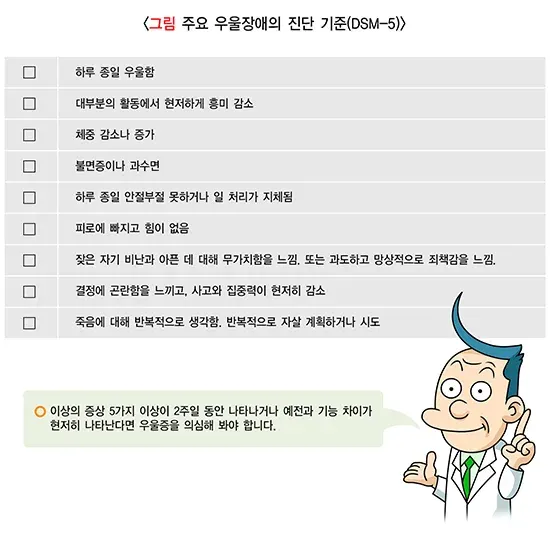
11. American Psychiatric Association. (2013). DSM-5.
12. Gualano, M. R., Bert, F., Martorana, M., Voglino, G., Andriolo, V., Thomas, R., . . . Siliquini, R. (2017). The long-term effects of bibliotherapy indepression treatment: Systematic review of randomized clinical trials. Clin Psychol Rev, 58, 49-58. doi:10.1016/j.cpr.2017.09.006
13. Brady, K. T., Killeen, T. K., Brewerton, T., & Lucerini, S. (2000). Comorbidity of psychiatric disorders and posttraumatic stress disorder. J ClinPsychiatry, 61 Suppl 7, 22-32.
14. Barefoot, J. C., & Schroll, M. (1996). Symptoms of depression, acute myocardial infarction, and total mortality in a community sample.Circulation, 93(11), 1976-1980.
15. Bonde, J. P. (2008). Psychosocial factors at work and risk of depression: a systematic review of the epidemiological evidence. OccupEnviron Med, 65(7), 438-445.
16. Chen, Y. W., & Dilsaver, S. C. (1995). Comorbidity of panic disorder in bipolar illness: evidence from the Epidemiologic Catchment AreaSurvey. Am J Psychiatry, 152(2), 280-282. doi:10.1176/ajp.152.2.280
17. Choi, K. W., Chen, C. Y., Stein, M. B., Klimentidis, Y. C., Wang, M. J., Koenen, K. C., . . . Major Depressive Disorder Working Group of thePsychiatric Genomics, C. (2019). Assessment of Bidirectional Relationships Between Physical Activity and Depression Among Adults: A 2-Sample Mendelian Randomization Study. JAMA Psychiatry. doi:10.1001/jamapsychiatry.2018.4175
18. Davis, L., Uezato, A., Newell, J. M., & Frazier, E. (2008). Major depression and comorbid substance use disorders. Curr Opin Psychiatry.21(1), 14-18. doi:10.1097/YCO.0b013e3282f32408
19. Frasure-Smith, N., Lesperance, F., & Talajic, M. (1993). Depression following myocardial infarction. Impact on 6-month survival. JAMA,270(15), 1819-1825.
20. Ford, D. E., & Kamerow, D. B. (1989). Epidemiologic study of sleep disturbances and psychiatric disorders. An opportunity for prevention?.JAMA, 262(11), 1479-1484.
21. Gilman, S. E., & Abraham, H. D. (2001). A longitudinal study of the order of onset of alcohol dependence and major depression. DrugAlcohol Depend, 63(3), 277-286.
22. Horwath, E., Johnson, J., Weissman, M. M., & Hornig, C. D. (1992). The validity of major depression with atypical features based on acommunity study. J Affect Disord, 26(2), 117-125.
23. Jung SJ, Woo HT, Cho S, Park K, Jeong S, Lee YJ, … Shin A. (2019). Association between body size, weight change and depression:systematic review and meta-analysis. British Journal of Psychiatry, 211(1), 14-21.
24. Katon, W. J. (2003). Clinical and health services relationships between major depression, depressive symptoms, and general medicalillness. Biol Psychiatry, 54(3), 216-226.
25. Kennedy, S. H. et al. (2016). Canadian Network for Mood and Anxiety Treatments (CANMAT) 2016 Clinical Guidelines for the Managementof Adults with Major Depressive Disorder: Section 3. Pharmacological Treatments. Can J Psychiatry, 61(9). 540-60.
26. Kessler, R. C., Berglund, P., Chiu, W. T., Demler, O., Heeringa, S., Hiripi, E., . . . Zheng, H. (2004). The US National Comorbidity SurveyReplication (NCS-R): design and field procedures. Int J Methods Psychiatr Res, 13(2), 69-92.
27. Klainin-Yobas, P., Oo, W. N., Suzanne Yew, P. Y., & Lau, Y. (2015). Effects of relaxation interventions on depression and anxiety amongolder adults: a systematic review. Aging Ment Health. 19(12), 1043-1055. doi:10.1080/13607863.2014.997191
28. Lai, J. S., Hiles, S., Bisquera, A., Hure, A. J., McEvoy, M., & Attia, J. (2014). A systematic review and meta-analysis of dietary patterns anddepression in community-dwelling adults. Am J Clin Nutr, 99(1), 181-197. doi:10.3945/ajcn.113.069880
29. Lesperance, F., Frasure-Smith, N., St-Andre, E., Turecki, G., Lesperance, P., & Wisniewski, S. R. (2011). The efficacy of omega-3supplementation for major depression: a randomized controlled trial. J Clin Psychiatry, 72(8), 1054-1062. doi:10.4088/JCP.10m05966blu
30. Ludman, E. J., Katon, W., Russo, J., Von Korff, M., Simon, G., Ciechanowski, P., … Young, B. (2004). Depression and diabetes symptomburden. Gen Hosp Psychiatry, 26(6), 430-436. doi:10.1016/j.genhosppsych.2004.08.010
31. Luppino, F. S., de Wit, L. M., Bouvy, P. F., Stijnen, T., Cuijpers, P., Penninx, B. W., & Zitman, F. G. (2010). Overweight, obesity, anddepression: a systematic review and meta-analysis of longitudinal studies. Arch Gen Psychiatry, 67(3), 220-229.
32. Mammen, G., & Faulkner, G. (2013). Physical activity and the prevention of depression: a systematic review of prospective studies. Am JPrev Med, 45(5), 649-657. doi:10.1016/j.amepre.2013.08.001
33. Martin, C. S., Arria, A. M., Mezzich, A. C., & Bukstein, O. G. (1993). Patterns of polydrug use in adolescent alcohol abusers. Am J DrugAlcohol Abuse, 19(4), 511-521.
34. Mazure, C. M. (1998). Life stressors as risk factors in depression. Clinical Psychology: Science and Practice, 5(3), 291-313.
35. McDaniel, J. S., Musselman, D. L., Porter, M. R., Reed, D. A., & Nemeroff, C. B. (1995). Depression in patients with cancer. Diagnosis,biology, and treatment. Arch Gen Psychiatry, 52(2), 89-99.
36. Mokhber, N., Namjoo, M., Tara, F., Boskabadi, H., Rayman, M. P., Ghayour-Mobarhan, M., . . . Ferns, G. (2011). Effect of supplementationwith selenium on postpartum depression: a randomized double-blind placebo-controlled trial. J Matern Fetal Neonatal Med, 24(1), 104-108.doi:10.3109/14767058.2010.482598
37. Penders, T. M., Stanciu, C. N., Schoemann, A. M., Ninan, P. T., Bloch, R., & Saeed, S. A. (2016). Bright Light Therapy as Augmentation ofPharmacotherapy for Treatment of Depression: A Systematic Review and Meta-Analysis. Prim Care Companion CNS Disord. 18(5).doi:10.4088/PCC.15r01906
38. Pospos, S., Young, I. T., Downs, N., Iglewicz, A., Depp, C., Chen, J. Y., . . . Zisook, S. (2018). Web-Based Tools and Mobile Applications ToMitigate Burnout, Depression, and Suicidality Among Healthcare Students and Professionals: a Systematic Review. Acad Psychiatry, 42(1),109-120. doi:10.1007/s40596-017-0868-0
39. Quarantini, L. C., Torres, A. R., Sampaio, A. S., Fossaluza, V., Mathis, M. A., do Rosario, M. C., . . . Koenen, K. C. (2011). Comorbid majordepression in obsessive-compulsive disorder patients. Compr Psychiatry, 52(4), 386-393. doi:10.1016/j.comppsych.2010.09.006
40. Roy-Byrne, P. P., Stang, P., Wittchen, H. U., Ustun, B., Walters, E. E., & Kessler, R. C. (2000). Lifetime panic-depression comorbidity in theNational Comorbidity Survey. Association with symptoms, impairment, course and help-seeking. Br J Psychiatry, 176, 229-235.
41. Ross, H. E. (1995). DSM-III-R alcohol abuse and dependence and psychiatric comorbidity in Ontario: results from the Mental HealthSupplement to the Ontario Health Survey. Drug Alcohol Depend, 39(2), 111-128.
42. Rutledge, T., Reis, V. A., Linke, S. E., Greenberg, B. H., & Mills, P. J. (2006). Depression in heart failure a meta-analytic review ofprevalence, intervention effects, and associations with clinical outcomes. J Am Coll Cardiol, 48(8), 1527-1537.doi:10.1016/j.jacc.2006.06.055
43. Sanchez-Vidana, D. I., Ngai, S. P., He, W., Chow, J. K., Lau, B. W., & Tsang, H. W. (2017). The Effectiveness of Aromatherapy forDepressive Symptoms: A Systematic Review. Evid Based Complement Alternat Med, 2017, 5869315. doi:10.1155/2017/5869315
44. Sheline, Y. I. (2000). 3D MRI studies of neuroanatomic changes in unipolar major depression: the role of stress and medical comorbidity.Biol Psychiatry, 48(8), 791-800.
45. Solomon, D. A., Keller, M. B., Leon, A. C., Mueller, T. I., Lavori, P. W., Shea, M. T., . . . Endicott, J. (2000). Multiple recurrences of majordepressive disorder. Am J Psychiatry, 157(2), 229-233. doi:10.1176/appi.ajp.157.2.229
46. Sullivan, P. F., Neale, M. C., & Kendler, K. S. (2000). Genetic epidemiology of major depression: review and meta-analysis. Am J Psychiatry,157(10), 1552-1562. doi:10.1176/appi.ajp.157.10.1552
47. Tuunainen, A., Kripke, D. F., & Endo, T. (2004). Light therapy for non-seasonal depression. Cochrane Database Syst Rev(2), Cd004050.doi:10.1002/14651858.CD004050.pub2.
48. United States. Department of Health and Human Services. (2008). 2008 physical activity guidelines for Americans : be active, healthy, andhappy! Washington, DC: U.S. Dept. of Health and Human Services.
49. WHO. (2017). Depression and Other Common Mental Disorders.
50. Wilson, S., Vaidyanathan, U., Miller, M. B., McGue, M., & Iacono, W. G. (2014). Premorbid risk factors for major depressive disorder: arethey associated with early onset and recurrent course? Dev Psychopathol, 26(4 Pt 2), 1477-1493. doi:10.1017/S0954579414001151
51. Wittchen, H. U., Zhao, S., Kessler, R. C., & Eaton, W. W. (1994). DSM-III-R generalized anxiety disorder in the National Comorbidity Survey.Arch Gen Psychiatry, 51(5), 355-364.